




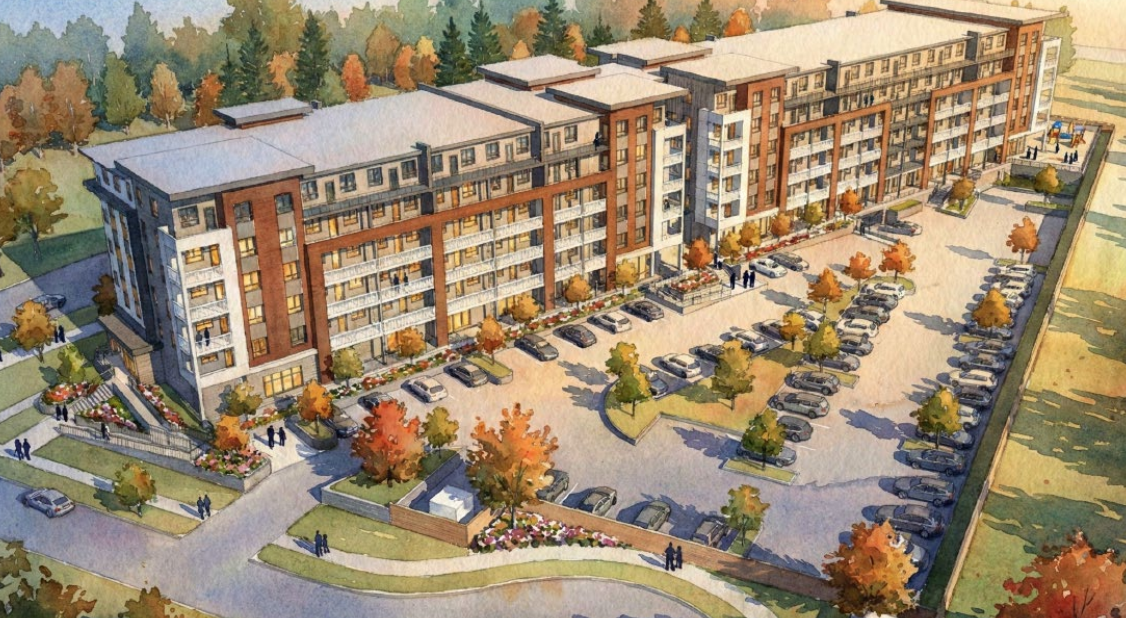
Residents of Squamish’s Northyards neighbourhood are pushing back against a developer’s request to reduce parking spaces in a proposed six-storey rental building on Aspen Road, warning the variance will worsen an already strained parking situation.
The development, planned for an 8,490-square-metre lot at the corner of Aspen Road and Pioneer Way, would include 153 apartments, 10 live-work units and a 393-square-metre commercial space. The developer has requested 180 parking spaces, 107 fewer than the current zoning bylaws require.
“Parking is already stretched to the limit in our community,” wrote longtime resident Mallory Hewlko in a submission opposing the variance. “Over the past decade, I’ve watched the available parking in our area shrink steadily while the population has grown.”
Under current zoning regulations, the project would require 287 parking spaces. The developer is requesting the downtown parking rate of one space per dwelling unit and two spaces per 100 square metres of commercial floor space.
Resident Kathleen questioned where the extra vehicles would go. “North Yards is already getting so congested with many cars parking on side streets, and with the district cracking down on parking infractions, it seems hypocritical for the district to allow the proposed 178 parking spaces to go through,” she wrote.
Several residents argued that the parking reduction ignores the reality of how people live and work in Squamish. Bethan Haston noted that high housing costs mean many apartments are shared by multiple adults who each need vehicles.
“Many Squamish residents commute to Whistler or Vancouver for work because local wages can’t keep up with housing costs,” Hewlko wrote. “Reliable public transit between those areas is non-existent, making car ownership a requirement, not a luxury.”
Rob Stokes echoed those concerns, adding that reduced parking fails to account for elderly or disabled residents who cannot bike or walk for transportation, particularly during Squamish’s wet and snowy weather.
District staff are supporting the parking reduction, citing the site’s proximity to transit, employment and amenities. The location falls on the Frequent Transit Network, and staff argue the reduction aligns with the Community Climate Action Plan’s goal to discourage private vehicle use and the Transportation Master Plan’s direction to remove parking minimums.
Staff also noted that rental projects typically require concessions, such as reduced parking, to remain financially feasible, and that the Official Community Plan supports incentives for the creation of rental housing.
The application proposes rezoning the currently undeveloped site from C-13 to a new CD-120 zone. The building would feature parking and bike storage on the ground level, with the first habitable storey elevated above. Twenty percent of units would be three-bedroom or two-bedroom plus den configurations, exceeding BC Housing Design Guidelines.

Are they talking about the Transit in Squamish that doesn’t really go where the jobs actually are – Whistler, Vancouver or even just local construction sites, Gondola, The Canyon etc and the Transit that takes much, much longer to arrive at your destination than driving your own vehicle? That Transit? Why does “Staff” have so much power in this town? and why does “Staff” believe reduced parking is the only way for a development to remain financially feasible??????? Did a developer tell them that and it’s become their truth now…..
I agree with enough’s comment.
Transit is not frequent enough and Squamish IS the commuter town to whistler and Vancouver (with no transit anvailable) of course everyone drives and has a car. Also we no longer live in the day and age of “one car per household”. These units will have a min of two cars each and heaven forbid if you have 3-4 people who rent and are housemates who each have a car. There is no good reason to reduce the number of parking spaces! Squamish is an adventure destination, not a city.
I agree with enough’s comment.
Squamish IS the commuter town to whistler and Vancouver (with no transit anvailable) so of course everyone has a vehicle. Also we no longer live in the day and age of “one car per household”. These units will have a min of two cars each and forbid if you have 3-4 people who rent, are housemates and each have a car. There is no good reason to reduce the number of parking spaces! Squamish is an adventure destination, not Vancouver city with ample and consistent transit
The Council of Squamish is being run by the staff of the district.
Hello Enough,
Yes, that transit system. Transit users don’t think like vehicle owners. What they know is that riding the bus is quicker than walking or cycling. Staff have no power. Staff takes direction from Council decisions. The seven members of Squamish Council have the power. If they feel more parking spots will be needed at this development they’ll demand more parking spots.
And, by the time this building is ready to be lived in there will likely be a regional transit service to Whistler and the North Shore. All signs are posting to a regional transit announcement in the year ahead.
How long have we been hearing that transit will be to whistler and the north shore. Maybe give your head a shake. Have any of the council members ever taken transit, walked or ridden a bike in the weather that we have been experiencing? It was said most families have two cars not just for work but for different schedules including kids activities having to go different directions and never mind carrying equipment for those activities.
Hi Optimistic,
In a quick glance at transit options between Garibaldi Estates and a few locations downtown it is significantly faster to cycle than take transit. That is provided you want to leave when the hourly transit service comes by the local stop and not need to be somewhere for a specific time. Cycling or driving would provide significantly more flexibility and time savings taking that into consideration.
Aside from busses leaving Don Ross after school I see very few busses with more than a few people on them. I haven’t been following regional transit particularly closely but at introduction I assume we are talking about hourly service if we are lucky to start, at commuter hours? If one needs to take local transit to get to regional transit and then potentially another connection in Vancouver or Whistler you’re talking about significant extra time in the day for commuting. Missing out on family time, activities, socializing, spending it on a bus instead. While I haven’t taken Squamish Connector I have to wonder if it is not servicing the people who live close to it and work close to drop off in the city, the ones without a protracted commute.
The regional transit crowd in town is very loud. The population of this town that supports extra vehicles is quiet in comparison. Look around at the number of extra vehicles parked in creative places, on side streets, on lawns all over town. I’d believe the majority at this point has voted one vehicle is not enough and they are not involved with local politics or silent on the issue. Council appears blind to the number of people who buy or rent these new buildings with a single parking stall and then scramble to street park their second or third vehicle.
While regional transit will definitely provided benefits to our community I feel it is being hailed as a holy grail and is the main justification for these parking reductions. In reality I suspect it will achieve less than advertised at introduction and many will still rely on a second vehicle. If we have a similary Squamish council when transit launches there will be some crazy new ideas or taxes implemented to justify all of the parking reductions and force people into transit. Perhaps then the silent majority will wake up.
Over the past 15 years, I’ve watched Squamish’s planning decisions systematically ignore the reality of how residents actually live and work in this community. The proposed Northyards development on Aspen Road is the latest example of this troubling pattern.
I agree with the concerns raised by Mallory Hewlko, Kathleen, and others: Squamish is a commuter town serving workforces in Vancouver and Whistler. This isn’t opinion—it’s demographic fact. The district staff’s justification for reducing parking from 287 to 180 spaces relies on the existence of a “Frequent Transit Network” that simply doesn’t serve the routes most residents need.
The proposed reduction of 107 parking spaces isn’t just a variance—it’s a 37% cut from what current zoning recognizes as necessary. District staff argues this aligns with climate action goals and makes the project “financially feasible” for the developer. But this logic shifts the cost burden from the developer onto existing residents who will face increased street parking competition, enforcement, and neighborhood congestion.
Bethan Haston makes a critical point: high housing costs mean multiple working adults share these units, each requiring their own vehicle. When you combine this with Squamish’s role as a bedroom community for Whistler and Vancouver—destinations with no viable public transit connections—the district’s “one space per unit” formula becomes dangerously detached from reality.
The staff report mentions the Community Climate Action Plan’s goal to discourage private vehicle use. I support that goal. But implementing parking reductions before establishing functional transit alternatives doesn’t reduce car dependency—it just forces those cars onto residential streets. The district is effectively punishing residents for transportation infrastructure it hasn’t built yet.
This is also a question of equity. As Rob Stokes notes, reduced parking fails elderly and disabled residents who cannot use bikes or walk in Squamish’s winter weather. We’re creating housing that assumes all residents are able-bodied adults who can somehow manage without vehicles despite the absence of practical alternatives.
My recommendation to council: Deny this parking variance until meaningful Sea-to-Sky regional transit exists—not aspirational plans, but actual operating service that connects Squamish residents to Vancouver and Whistler workplaces. In the meantime, hold developers to existing parking standards. If that makes projects less “financially feasible,” then council needs to find other incentives for rental housing that don’t externalize costs onto neighborhoods already struggling with parking scarcity.
Squamish’s future depends on growth. But sustainable growth requires honest planning that acknowledges how this community actually functions today, not wishful thinking about how staff hopes it will function someday.