





The District of Squamish is considering recognizing dozens of municipally owned parks and green spaces as conservation lands in the Canadian Protected and Conserved Areas Database (CPCAD). Council will discuss the proposal at a Committee of the Whole Meeting today.
This is part of Canada’s 30×30 conservation target, where Canada, along with 195 other countries, is committed to protecting 30 per cent of Canada’s land and oceans by 2030.
A report, prepared by the Howe Sound Biosphere Region Initiative Society, recommends submitting 70 hectares of District-owned P-3 zoned parcels, lands designated for park, recreation and institutional use, as Other Effective Area-Based Conservation Measures (OECMs) to the national database.
Unlike traditional protected areas, OECMs recognize conservation outcomes on lands that are not primarily set aside for environmental protection. In Squamish, many P-3 parcels already protect sensitive ecosystems through existing management, despite remaining open to public recreation.
“These are places where protection isn’t the primary purpose, they might be recreation areas or community spaces, but they still do their job in protecting biodiversity,” said Ruth Simons, executive director of the Howe Sound Biosphere Region Initiative Society. “It’s really about recognizing the conservation value that’s already there.”

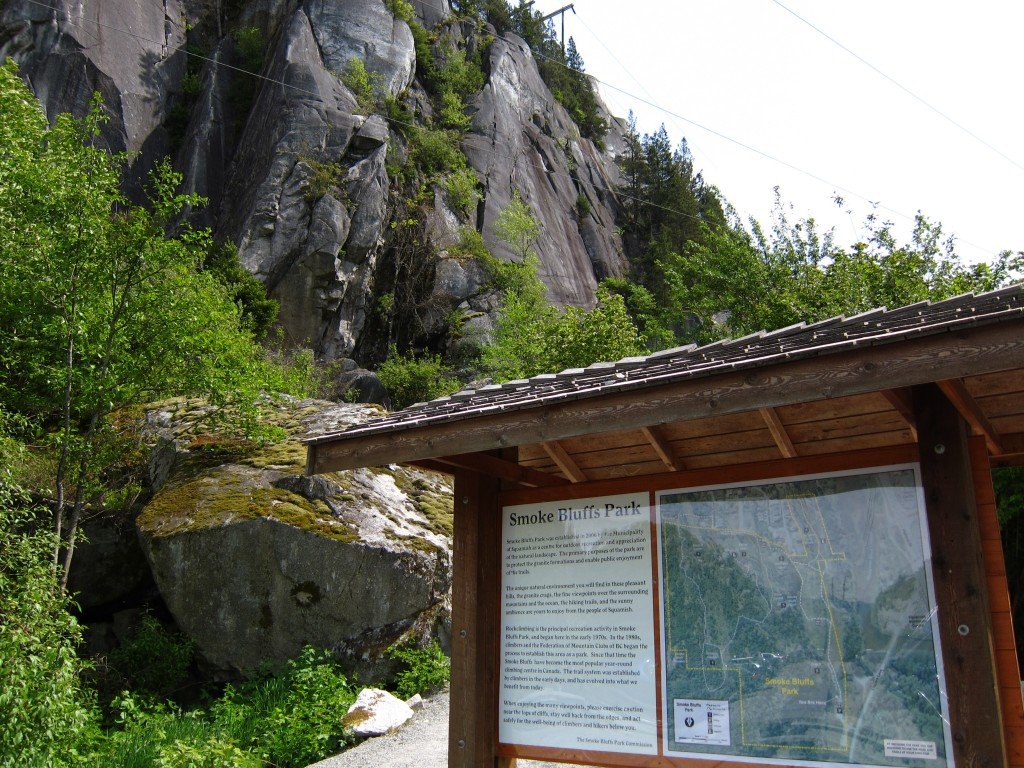
Potential candidate sites for Squamish OECMs include: Smoke Bluffs Park, Hospital Hill, Merrill Park, John Hunter Park, Rose Park and others. Together, the parcels help connect developed neighbourhoods with rivers, estuaries and existing protected lands.
These are a separate category in the database from the P-4 zoned, protected land, whose primary purpose is conservation.
Environment and Climate Change Canada has already approved 85 hectares of District-owned P-4 zoned protected areas, for use in the database. This land will appear in the national database by spring 2026, bringing about 20 per cent of Squamish’s land base under formal conservation recognition.
“If all of these [P-3] lands get registered, that brings the District of Squamish to about 21 per cent,” said Simons.

The work is fully funded through federal programs and led by the Howe Sound Biosphere Region, requiring minimal staff time from the District.
Simons said the proposed submissions also point to opportunities beyond this round of recognition.
“If the goal is 30 per cent, then it really encourages looking ahead, identifying other lands that could qualify and using planning tools, like wildlife connectivity, to support biodiversity as the community grows,” said Simons.

Healthy is debatable term for Merrill Park. Dwarf mistletoe is found on the north margin infesting both young and mid-aged Hemlock. This margin was the site of a rescue mission several years ago (2007) where a road into the area was established and numerous diseased Hemlock trees were felled and removed.
The deadfall and standing dead in the forest create a danger to users during impactful wind storms.
I am unable to find prescribed maintenance or treatment protocols for the “Park” to address these issues.
Further to these issues is the constant implementation of challenges and routes for recreational mountain biking.
This entire ecosystem is an interface fire zone. More than 25 homes share a property line with the Park which will prove disastrous if a fire is ever established in it.
The Park borders on its northwest side with undeveloped lands owned by a major developer and someday will be impinged on that margin as well, likely with strong demands for interface mitigation.
Further to that, the homes on the north margin are receiving less sunshine annually. Our home in particular receives no direct sunshine from early October thru to late February. This makes the generation of solar power impossible during those month.
The aesthetic of the urban forest has value. But not when the issues mentioned above are ignored by the proponents of bio-sphere integrity, one only has to look to the north, west and east margins of the District to recognize that we don’t suffer from a loss of forest.