






A new on-demand transit service has launched in Squamish, offering residents in several underserved neighbourhoods a way to book bus rides through a smartphone app or by phone. Developed through a partnership between BC Transit and the District of Squamish, the service is the next phase of a pilot model the province first tested in Kelowna.
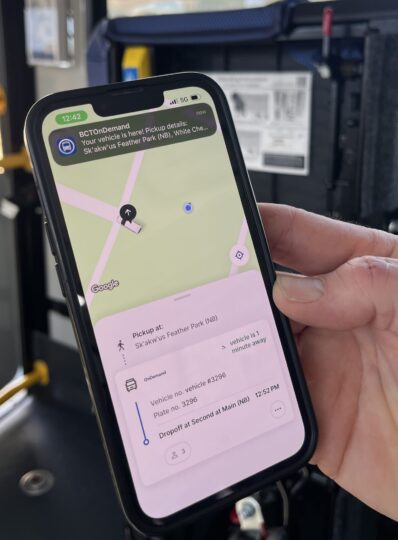
The service connects the Oceanfront, Redbridge, SEAandSKY, and St’á7mes neighbourhoods with limited transit, to the wider transit network in Downtown Squamish. The process is almost like ordering from a ride share app, with a few key differences. It’s not a door to door service like HandyDart, although there is ramp access and spaces for multiple wheelchairs on board. Instead, there are 40 different ‘virtual stops’ across the coverage area. The app prompts you to go to the nearest one when booking a ride.  For those without a smartphone, a phone line connects callers to a live dispatcher who books the ride on their behalf, and informs them of the nearest virtual stop. Currently, the service runs Monday through Friday from 8:15 a.m. to 6:45 p.m., with two buses deployed and one held in reserve for maintenance coverage.
 Once the brand new light-duty bus arrives to pick you up, riders can pay for the ride just like any other bus; with the UMO app, with cash, or with a physical pass.
Rob Ringma, a senior official with BC Transit, says the agency drew on its Kelowna experience when identifying where the model would be most effective. High-frequency corridors remain best served by fixed routes, he noted, but communities with dispersed demand and coverage gaps are well suited to the on-demand approach.
“We started talking to local municipal partners about their systems and where it may and would fit in,” Ringma said. “The South Squamish area seemed like a really good fit.”
The service is funded through the standard provincial transit partnership model, with the District of Squamish covering 53 percent of operating costs and BC Transit contributing the remaining 47 percent on behalf of the province. All fare revenue flows back to the District to help offset expenses.
Dora Gunn, Transportation Planner at the District of Squamish, noted that the council had been interested in on-demand transit for a long time.
“It’s tricky when you don’t have high-density areas to provide good, frequent transit,” she said. “Council saw this as something that might work well for Squamish.”
Gunn also pointed to the service’s reach into three growing neighbourhoods: Oceanfront, Sea to Sky, and Red Ridge, none of which currently have transit coverage. Squamish Nation was engaged early in the planning process as well, after its climate action plan identified a transit gap around Totem Hall. According to BC Transit, the Squamish Nation conducted community engagement and has been involved in promoting the service to its members.
Behind the scenes, the BC Transit OnDemand app handles booking, dispatch, and route optimization. When multiple rides are booked simultaneously, the system automatically adjusts the route to accommodate additional passengers, and improves as ridership data accumulates. The downtown core is excluded from trips that begin and end within its boundaries, as fixed-route service already operates there, but rides from the covered neighbourhoods into downtown are fully available.
The service which launched March 30, is just getting up to full speed. Ringma said that people near the bus staging areas have approached the bus asking for a ride. In the coming weeks, the agency plans to more actively promote the service, working with the District and Squamish Nation to reach residents in target neighbourhoods directly.
Weekend service hasn’t been introduced but Ringma noted it could be added if demand warrants it. The on-demand service will bolster transit to Oceanfront, which is only serviced by Route 5 during the summer tourist season.
Both BC Transit and the District view the service as part of a broader effort to align transit investment with the community’s growth.
“We’re continuing to think about transit expansions in those areas that line up with where residential areas are going to be growing,” Ringma said. “This on-demand implementation is a good example of identifying where there are gaps and trialing an innovative approach to address them.”
