




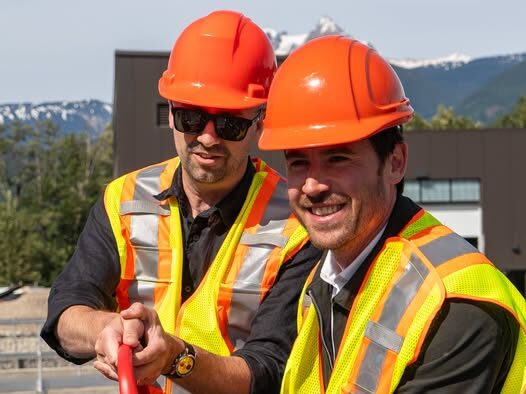
A ribbon-cutting ceremony June 1 marked the completion of $12.8 million in upgrades to the Squamish Wastewater Treatment Plant. The district says it will help the community keep pace with rapid population growth.

The ceremony was attended by West Vancouver-Sunshine Coast-Sea to Sky Country MP Patrick Weiler, Mayor Armand Hurford, and members of council.
Work began in 2023 on the aging facility, which was nearing capacity and no longer met current seismic and flood protection standards. The upgrades included construction of a new secondary clarifier, a concentric ring bioreactor, and a septage receiving station. Existing infrastructure was also optimized, with a redundant clarifier tank converted into a primary clarifier to extend its useful life.

The improvements are designed to increase treatment capacity, improve effluent quality, reduce carbon emissions, and provide greater resilience against natural disasters. The new circular clarifier and bioreactor is built to post-disaster standards, meaning it is designed to remain operational following a seismic or flood event.
The $12.8 million project was funded in part through the federal Investing in Canada Infrastructure Program, with the federal government contributing $4.03 million and the province contributing $3.36 million.
 “Communities like Squamish cannot grow without the infrastructure to support them,” Weiler said. “The upgrade to the Mamquam Wastewater Treatment Plant will help protect the rivers and waterways that define this region, while ensuring the community can continue building the housing and services people rely on. This is a significant investment in Squamish’s future and a strong example of how infrastructure, environmental stewardship, and sustainable growth must go hand in hand.”
Mayor Hurford echoed that sentiment, highlighting the range of benefits the upgrades deliver. “This upgrade reflects our work to ensure that vital municipal infrastructure keeps up with population growth and community expansion,” he said. “The upgrades also serve to improve plant performance and effluent quality and decrease carbon emissions and handling costs. We are grateful for the support of our federal and provincial partners to complete these important upgrades.”