


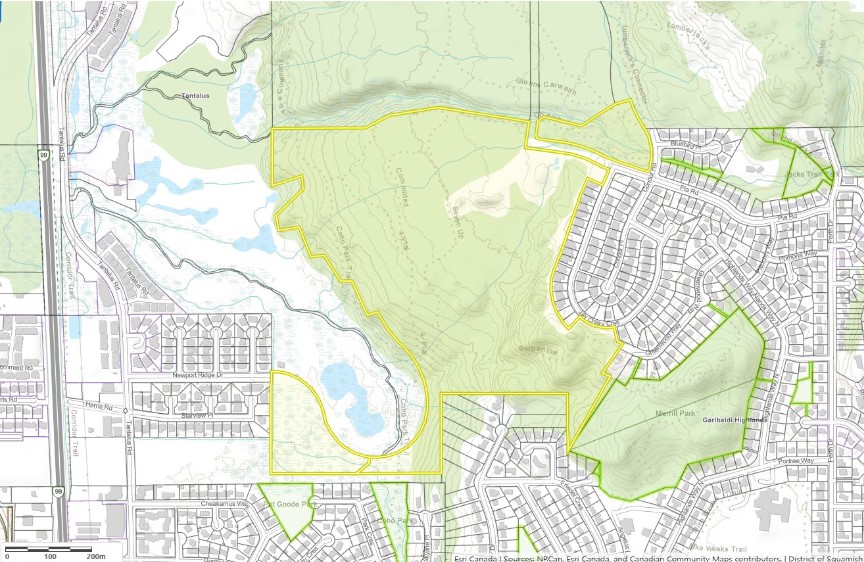
The District of Squamish Council voted on June 23, 2026 to endorse the engagement strategy for the Newport Ridge Neighbourhood Plan, which will shape how the public gets a say in how the roughly 8.1 hectares of land between the Garibaldi Estates and Garibaldi Highlands neighbourhoods gets used.

The application dates back to May 2023, when developer Holborn Group applied for an Official Community Plan amendment to create a neighbourhood plan for the site. The land sits within the District’s Growth Management Boundary and is designated for residential growth in the OCP, but it remains undeveloped today, accessible only by trails from Newport Ridge Drive in the west and Pia Road and Greenwood Way in the east. The property includes second growth forest, rocky terrain, steep hillsides, riparian setbacks, a crushed rock stockpile left over from previous development nearby, and recreational trails used by the surrounding community.

The engagement strategy was prepared for the developer by MODUS Planning, Design and Engagement Inc., a third party consultant. It lays out a five stage planning process, with three formal rounds of public engagement built into stages two through four.
The first round will focus on gathering community values and priorities through an in person event. The second will involve workshops and informal “picnic table” conversations about plan options, covering things like housing form, site connectivity, and open space.

The third will be a drop in open house centered on the draft plan itself. Each round is meant to be followed by a summary report back to council, with the explicit goal of making sure the public has already seen and weighed in on the plan before the formal public hearing required for any OCP amendment. Planner Aja Philp put it, the approach is meant to “ensure that the community is not reviewing the full neighbourhood plan for the first time during the formal OCP amendment bylaw process.”

A key piece of the early work involves what staff called front loading the technical reports. Before engagement on design options begins, staff and the applicant’s team intend to map out which parts of the site simply cannot be developed due to steep slopes, geotechnical issues, or riparian constraints. Philp told council the intent is to “know what is remaining that we have to work with” once those areas are set aside, so that later public input can focus on land that is realistically buildable.
The strategy identifies a long list of groups to be engaged beyond the general public, including adjacent neighbourhood associations, environmental and trail organizations, business groups, seniors and youth service providers, school groups, and various provincial and federal agencies with jurisdiction over things like transportation, fisheries, and the environment. Engagement with Squamish Nation is being treated separately from the rest of the strategy. Staff plan to begin outreach after implementing council’s feedback on this strategy.
Staff said the project is expected to take about two years once technical reports are complete, though the pace will depend partly on how quickly the developer responds to requests from staff.
Council endorsed the engagement strategy, but asked staff to come back with an updated list of stakeholders, clearer definitions of roles and responsibilities among the parties involved, and a more detailed engagement timeline before moving into full implementation.


This is disgraceful! Ruining our beautiful town!
How bout we just hit the pause button on growth already !! Let the existing unfinished developments finish ~ wait til we have a bigger hospital ~ all amenities for that matter , and stop terrorizing the wildlife that are just trying to live in harmony with us.