


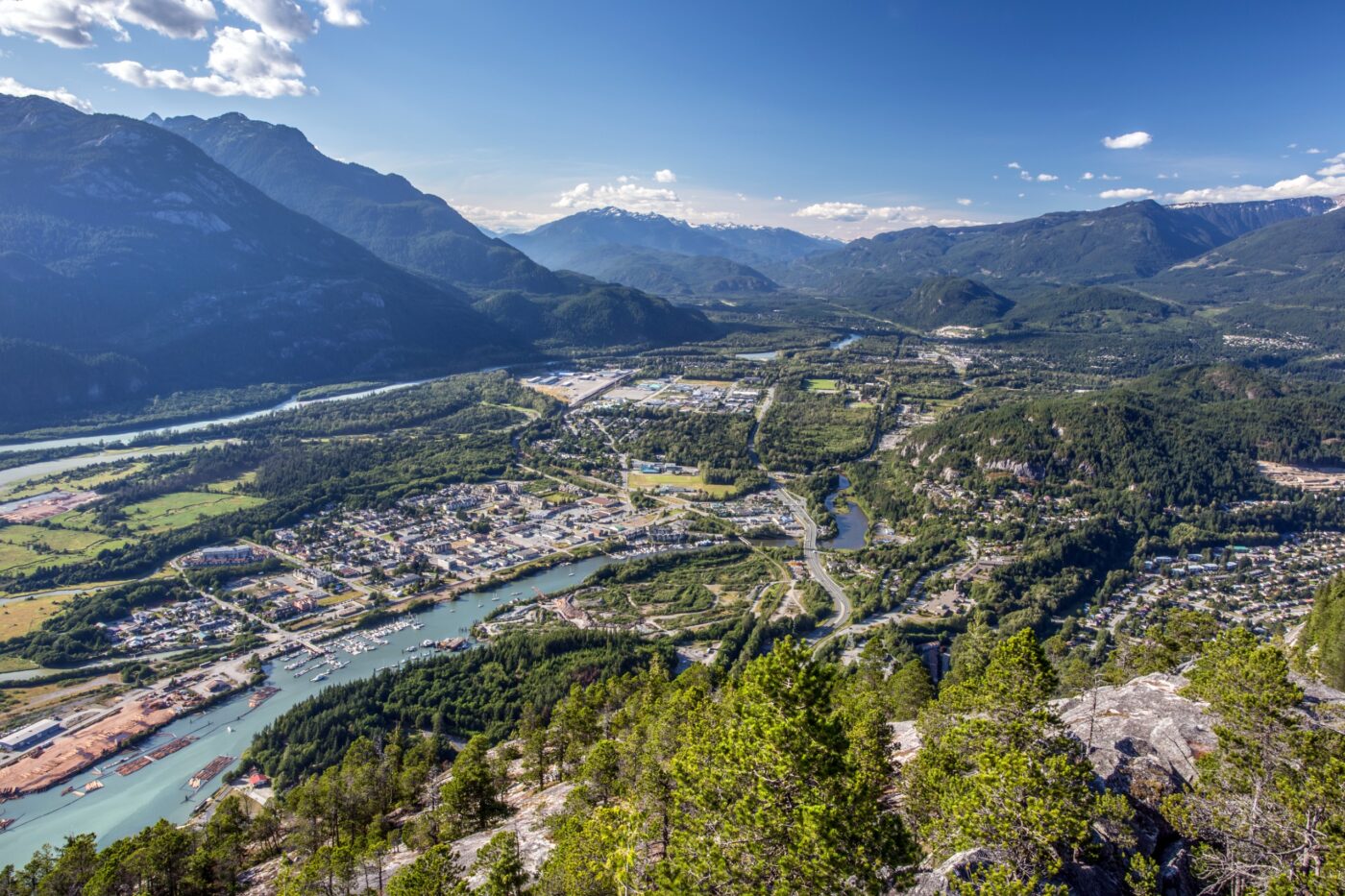
District of Squamish staff are presenting a steep slopes report to council on May 12, following public feedback. Public feedback was collected through an online survey and two open houses this past April, and helped inform some adjustments to the proposed bylaw.
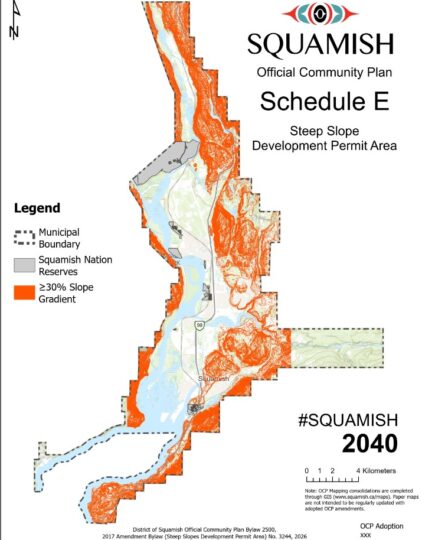
 The proposed rules, would require a development permit before anyone subdivides land, starts construction, removes trees, or excavates more than 1.2 m of soil on any property with a slope of 30 per cent or greater. That covers a significant swath of Squamish’s hillsides, visible in a District map showing large areas of orange extending up the mountainsides flanking the valley.
The rules were developed over the past year by District planning staff working with geotechnical engineers from Westrek Geotechnical Services and Fronterra Geotechnical, and informed by how other B.C. municipalities handle steep terrain.
 The bylaw would entail stricter guidelines around fire access. Strata developments would be required to build internal roads to the same grade standards as public District roads, a departure from current practice that allows steeper private grades. The Fire Department raised the issue, concerned that heavily loaded engines navigating steep strata roads face delays that translate directly into larger, harder to control fires.
Respondents largely agreed that hillside development needs better guardrails. But there was disagreement on how far the district’s proposed rules should go. The proposed bylaw has drawn support from neighbours worried about landslides and visual blight, but some pushback from developers who say the added costs could make construction even harder in an already expensive market.
Public feedback was collected through an online survey and two open houses at St. John the Divine Anglican Church in Garibaldi Estates this past April. Of 45 survey respondents, 71 per cent said addressing the visual impacts of hillside development was very or moderately important, and 73 per cent supported requiring strata roads to meet district grade standards.
 But the response was not uniformly positive. About a third of respondents felt the visual impact guidelines were too onerous, just over a third of respondents thought they were about right and another fifth thought they were too lenient. The guidelines in question require buildings to follow natural site contours rather than reshaping the land to suit the development, discourage extensive cut and fill to create large flat terraces, and restrict retaining walls taller than 1.2 m unless they are set back at least 6 m from a property boundary. Walls over 2 m must be screened with vegetation or buildings, and large blank concrete walls are explicitly prohibited.
Some respondents pushed back on those retaining wall limits specifically, arguing that restricting wall heights would actually force more intrusive terraced designs across a site. Others wanted more flexibility and innovation rather than prescriptive height limits.
 Development professionals raised broader concerns about financial burden, particularly on smaller properties, and suggested the district consider adding new requirements into existing approval processes rather than creating a separate permit stream.
In a written submission, one development company said the 30 per cent slope trigger was too blunt, arguing it would capture sites with minor steep sections where there is no meaningful safety risk. The letter also questioned whether the strata road grade requirement was consistent with the bylaw’s broader goal of minimizing cuts into natural topography, since gentler grades require wider and deeper road cuts through hillside terrain.
Staff made several adjustments to the draft in response to public feedback, including raising the excavation depth that triggers an engineering review from 0.5 m to 1.2 m and expanding the retaining wall height allowance to 2.4 m where walls are set back more than 6 m from a property boundary.
The Squamish Nation recommended that revegetation plans draw on a list of culturally significant plant species. That recommendation was incorporated into the bylaw’s vegetation guidelines.
If Council endorses the draft and directs staff to proceed, a formal amendment to the Official Community Plan would come forward for readings, with the District targeting completion by September 2026. Development of the permit area was funded through a $30,000 allocation from a Canada Mortgage and Housing Corporation Housing Action Fund grant.


My opinion is the dollar value of these fines is irrelevant if not enforced (or enforceable). I personally have never heard of anyone receiving a fine for these. I would be interested to know how many fines for these offences were issued in 2025, and how much revenue was generated.