


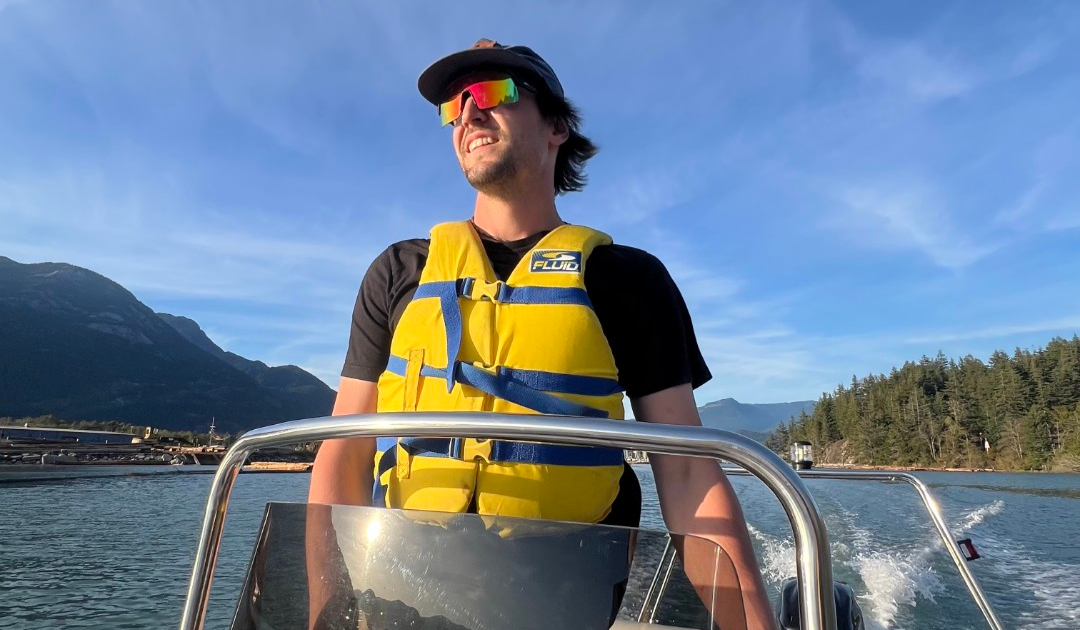
Jeremy Allen has been stranded on Highway 99 before. He estimates it has happened three or four times over the years, sometimes for so long he ended up sleeping in his car on the shoulder, waiting for the road to open. But when a fatal motorcycle crash near Deeks Creek Bridge shut the highway down in both directions on the evening of July 5, leaving himself stranded in Vancouver, he had an idea.

Allen owns Squamish Water Taxi, a small commercial marine operator on Howe Sound. Within about fifteen minutes of putting out a message offering to help, his phone started ringing. Ten calls came in. Fifteen minutes after that, it was forty, plus dozens of text messages, from people trying to get home to Bowen Island, get to work, or healthcare workers trying to get to work.
“It was insane,” Allen said.

Allen’s boat had actually been pulled out of the water the day before. He didn’t end up running it that night, since darkness was falling quickly and there wasn’t a clear enough emergency to justify it, but he kept a captain on call from a hotel room in case that changed. The experience, he said, was a wake up call.
“We’ve got to keep this in the water just in case stuff like this happens,” he said.

It never went anywhere Sunday night, but the volume of calls made the demand for an emergency service to transport supplies or medical personnel impossible to ignore for Allen.
Allen sent a letter to Transportation Minister Mike Farnworth and his staff, laying out a formal proposal for an on-call, cost-recovery marine response contract that the province could activate during full Highway 99 closures.

The proposal is built in tiers. The first, available immediately, uses Allen’s 19-foot RIB to move urgent medical transport, doctors, nurses and essential workers, and to run water, food, blankets and sleeping bags out to people stranded along the shoreline.
As Highway 99 runs close to Howe Sound for much of its length, he said the boat could reach nearly any point along the closure. The second tier centres on a 25-passenger water taxi Allen’s company already has on order, which he envisions running continuous evacuation loops once it arrives in a few months. The third and broadest tier would see Squamish Water Taxi coordinate with other marine operators in the Sea to Sky to build a round the clock emergency response network for the whole corridor.

Routes would flex to wherever the closure is, Allen said, from Squamish to Horseshoe Bay, Porteau Cove to Horseshoe Bay, or any other accessible stretch. Passengers would leave their vehicles behind under existing traffic management, and Allen has proposed a no-tow, no-ticket grace period until noon the following day so people can return for their cars once the highway reopens. Priority would go to medical cases, essential workers and families with young children and seniors, then everyone else still waiting to get home.
Allen is careful not to oversell his own company’s role in it.
“We’re just a water taxi business. We’re nothing special. It doesn’t need to be us. It can be anybody,” he said. He said he has already spoken informally with other marine operators in the corridor who do similar work and believes they would help if called on. He estimates that if several boat operators pooled their resources, they could move as many as 500 people up and down the corridor within two to three hours.
As for risk, Allen said rough water on Howe Sound is something his crews train for and deal with regularly. Conditions the night of the crash, he said, were calm.
While the ministry has received his proposal, Allen hasn’t got an official response yet. Allen said he plans to follow up and hopes for a real conversation with ministry or emergency management staff. He says he can immediately provide officials with vessel specs, Transport Canada certification, insurance details and cost structures.
Whether or not the province decides to fund it “we’re still going to run it,” he said. “We’re going to help people no matter what, even from our own pockets.”


GREAT IDEA! There is also community dock at Britannia Beach
In the event of an emergency, there should be a plan in place to move people to ‘safety’ anywhere along the Vancouver to Whistler corridor.
The amount of traffic on this road at anytime of the year is quite heavy. In the future, the numbers will only grow.
Currently there is a railway that parallels the Sea to Sky Hwy #99. Who owns this railway? Perhaps the owner, the public and politicians, that look after public well being could possibly come up with a solution to provide service in an emergency?
Another option might be a ferry service to take passengers and vehicles from Vancouver to Britannia Bay, in case of an emergency, or during high traffic periods. The owners of Britannia lands that include the mining museum and newly built residences and tourist stop, and our Provincial & Federal Government were short sighted not to include a BC Ferry dock, when setting out to develop and clean up this town for the purpose of providing a tourist attraction and housing, with taxpayer monies. This corridor is next to the Gulf Islands where several very small islands have the luxury of ferry service . Why not the Sea to Sky Corridor?
And yes, another viable business would be to call upon private fleets to transport people, by water, to
Safety. There’s plenty of ocean shores running along the Vancouver to Squamish corridor.
Love the idea. A needed service
How about flying the inspectors on site to get it done as soon as possible. Or having some in living in Squamish would be a time saver for sure.
I made a killing that night just using my zodiac and grabbing people to bring into squamish. I’m just a local trying to survive and I seen a way to help so I did
Should have a daily service like Hulu from Vancouver up sea to sky corridor
There should also be a infrastructure where a tow truck can come up on the opposite side from either Squamish or Vancouver or Whistler and remove some of the barriers and create a U-turn situation, perhaps some food trucks should come out and service people while they’re waiting. Heck they could even have Porta potties that get brought out.
These incidents happen so frequently that this could probably be a very viable business model.