



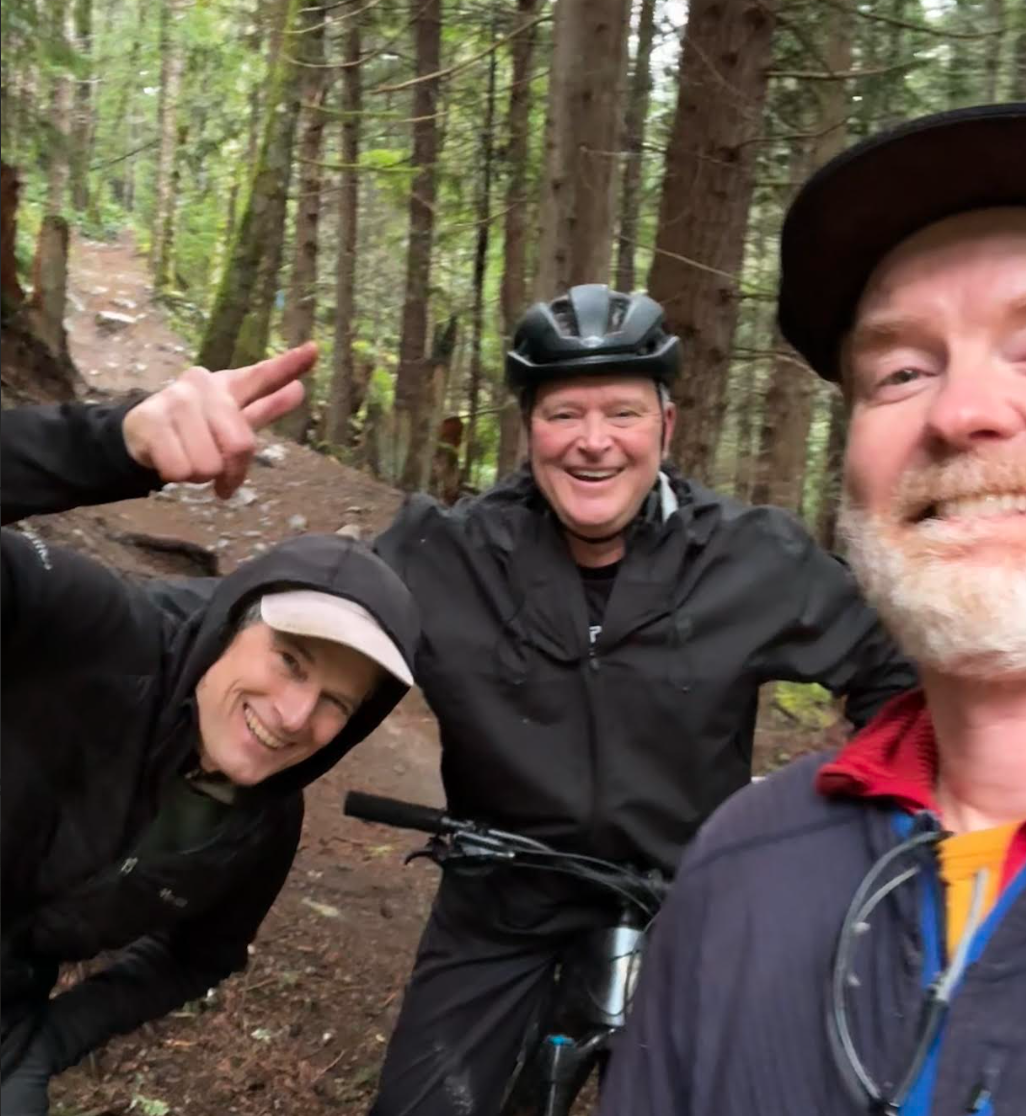
We never built these trails to make money. We built them because we believed everyone should have access to great riding.
Twenty-seven years ago, there were no big budgets, consultants, or trail economy. There were only volunteers—people with shovels, wheelbarrows, and a stubborn belief that Squamish could become one of the best places in the world to ride a mountain bike. Looking back, we probably underestimated what those trails would become.

Today, they support coaching businesses, guiding companies, shuttle operators, bike shops, hotels, restaurants, media projects, world-class events, local organizations, and a tourism economy that extends far beyond mountain biking. That is something worth celebrating. We are proud that people can make a living because of these trails, proud that riders travel from around the world to experience them, and proud that mountain biking has become part of Squamish’s identity.
Success was always the goal. But success also brings responsibility. The question is not whether people should make money from mountain biking—they should. The real question is whether everyone benefiting from volunteer-built public trails is helping protect them for the next generation. Many people already do. There are outstanding coaches, responsible guides, professional shuttle operators, exceptional events, dedicated contractors, and public agencies that work alongside volunteers to care for the trail network.
We have also been fortunate to partner with organizations such as Recreation Sites and Trails BC, BC Parks, Metro Vancouver, the District of Squamish, RMOW, the Village of Pemberton, the Squamish-Lillooet Regional District, and many others that have trusted volunteers to help manage and maintain public trails. Together, those partnerships have accomplished remarkable things, often with modest budgets and a shared commitment to doing the work properly.

That is what stewardship looks like. Success, however, has also created new challenges. If commercial coaching, guiding, and shuttling are taking place without the required authorizations or insurance, it is fair to ask whether existing rules are being applied consistently. Responsible operators should not have to compete against businesses that may avoid those responsibilities while using the very same public trails. That is not simply an enforcement issue. It is a stewardship issue.
Meanwhile, volunteers continue to donate thousands of hours every year to inspect bridges, clear drains, replace structures, repair trail tread, and rebuild trails that millions of wheels pass over. Riders are asked to donate, visitors are encouraged to contribute, and fundraisers never seem to end.
As mountain biking has grown into a major industry, it is also reasonable to ask for greater transparency about how maintenance priorities are determined, how funding is invested, and how success is measured. Those are not accusations; they are healthy questions. Good stewardship should welcome them.

Lately, we have read articles suggesting that our trails are struggling simply because there are too many riders. E-bikes are blamed. Visitor numbers are blamed. Popularity itself is blamed. We could not disagree more. If a trail is wearing out because people are riding it, that is a success in our eyes. Trails are built to be ridden.
We have never looked at a busy trail and concluded it was failing. We have looked at it and thought, people love this place. That simply means our responsibility is to build trails well, maintain them before they fail, and preserve the character that made people want to ride them in the first place.
The measure of a great trail is not how little maintenance it requires. It is how many people choose to ride it. Some of the very trails that put Squamish on the map are slowly losing the character that made them special, and that is worth talking about. We have never believed trails should be frozen in time. Trails evolve, and they should. But there is an important difference between maintaining a trail and reinventing it. Good maintenance protects a trail’s character; it does not erase it.
Not every trail should feel the same. Some should be smooth, while others should remain rough. Some should build confidence, while others should demand commitment. That variety is what creates progression, and progression is what makes a riding destination truly memorable.
Squamish earned its reputation because every trail had its own flavour. Every builder left a fingerprint, and every trail had a story. People do not travel here because our trails are generic. They come here precisely because they are not.
From everything we have seen, there are skilled people producing quality work every day. The bigger conversation is about direction. Are we preserving what made Squamish special? Are we filling the real gaps in our trail network? Are we protecting our trail heritage while creating opportunities for new riders? Are we investing maintenance dollars where they will have the greatest long-term benefit? These are not rhetorical questions or criticisms. They are the kinds of questions every successful trail community should continue asking if it wants to remain successful.
For twenty-seven years, we have watched volunteers accomplish extraordinary things with limited resources. Truthfully, we have always loved that challenge. Watching a handful of committed people build something that many believed could never be done has been one of the greatest privileges of our lives.
What has become harder to understand is how a volunteer movement became the foundation of a thriving recreation economy while volunteers continue to shoulder so much of the responsibility for maintaining it. We do not believe the answer is fewer riders. We do not believe the answer is blaming e-bikes. And we certainly do not believe success should mean sanding away the very character that made Squamish different in the first place.
Our community once prided itself not only on building incredible trails, but also on accountability, transparency, and a willingness to ask difficult questions. Those values deserve protecting just as much as the trails themselves. If you make a living from these trails—whether through coaching, guiding, shuttling, events, or tourism—we believe there is a responsibility to operate appropriately, obtain the necessary insurance and authorizations where required, and contribute where you can. That is not about creating barriers to business; it is about recognizing that every successful recreation economy depends on responsible stewardship of the public resource that makes it possible.
Likewise, if you support trail organizations, do not be afraid to ask questions. Where is the money going? What problems are we trying to solve? What does success actually look like? Healthy organizations should not fear those conversations. They should welcome them. Transparency builds trust, and trust is the foundation of every strong volunteer organization.
None of this is written out of bitterness. It is written out of gratitude. We are grateful to every volunteer who has ever picked up a shovel. We are grateful to every land manager who trusted volunteers to help care for public land. We are grateful to every contractor, business owner, event organizer, staff member, and community partner who continues to invest time and effort into making these trails better. Most of all, we are grateful that riders from around the world now dream of visiting Squamish to experience the trails that this community built together.
That is an extraordinary legacy. A volunteer movement built this place. An industry grew around it. Perhaps it is time for our stewardship to grow alongside it. Supporting responsible businesses, supporting volunteers, asking thoughtful questions, expecting transparency, and protecting the character that makes Squamish unique are not competing priorities. They are all part of the same responsibility. Because in the end, the trails did not build this community. The community built the trails.
Ted Tempany is a professional trail builder, founder of Dream Wizards, and longtime volunteer who has played a leading role in developing Squamish’s mountain bike trails.


That’s a wonderful presentation of our trail culture in Squamish. Yes I think all users should contribute to maintain and update the trail system. How that is done is a difficult formula. Perhaps looking at other large scale busy trail operations are managed would help. Making the local community aware of the challenges and welcome it to get involved, financially and or through volunteering. Keep up the fabulous work you do. Jim Lorman.
,
Thanks, Jim. I have a feeling this article won’t make the rounds with too many of the folks making a living from these trails. If you care about our trail network, please give it a share. The more people who understand the volunteer effort behind it, the better.